
Sterile Eye Pads: Non-Woven and Gauze Compared for Buyers
Non-woven versus gauze sterile eye pads, the four catalogue sizes and cartons, peel-seal checks and what fails at goods-in on a 2,500-pad carton.
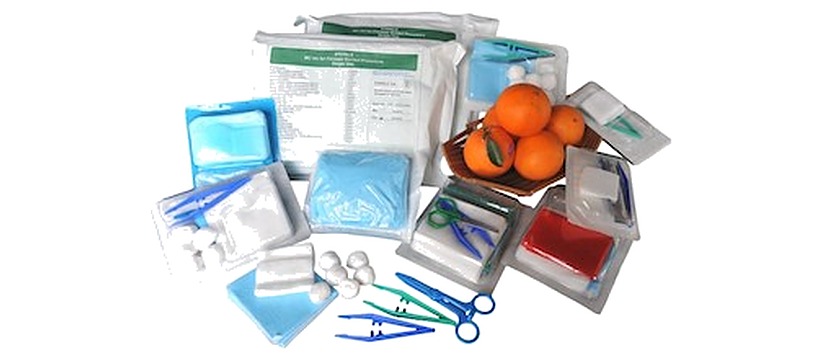
An eye pad looks like one of the simplest items on a medical consumables order: a small absorbent square, packed one to a peel pouch. In practice it is hard to buy well, because two pads carrying the same nominal size can differ in material, flatness, seal behaviour and in what happens when the pouch is opened in a hurry.
Buyers comparing quotations usually see one clear difference, the price gap between non-woven and gauze, and very little else. The price does not show whether the pad is flat or bowed, whether the peel seal is continuous, or whether the size printed on the pouch matches the pad inside. Those three decide whether the item is usable when needed.
What follows covers how the two materials behave, what the four catalogue sizes are and what each is specified against, why the pad usually arrives inside a dressing pack rather than loose, and the checks worth making before a carton of 2,500 pads is accepted.
Non-woven and gauze are not interchangeable
Both materials appear in the printed 2025 catalogue, in the same four sizes, at the same pack counts, and both are sterile. That symmetry is convenient for a price comparison and misleading for a specification; the two do different jobs.
Gauze is a woven cotton mesh with an open structure; non-woven is a bonded fibre web with a flatter surface.
| Property | Non-woven pad | Gauze pad |
|---|---|---|
| Material | Bonded fibre web | Woven cotton mesh |
| Absorbency | Holds fluid in the web, at a rate set by fibre and bonding | Wicks through the mesh quickly and holds fluid in the weave |
| Fibre shedding | Low at cut edges when the bond is sound | Loose fibres can lift at cut edges |
| Where buyers specify it | Flat pad that sits under a shield | Casualty dressing where rapid take-up matters |
| Carton | 2,500 pads per carton | 2,500 pads per carton |
Neither material is inherently better. The choice belongs to the clinical team, and the buyer's task is to write it down as a requirement and hold the supplier to it across lots.
Absorbency is the hardest property to judge from a data sheet. A pad can take up fluid quickly and release it under pressure, or take it up slowly and hold it. For an eye pad the second behaviour is usually wanted, since the pad sits under a shield.
Shedding gets less attention and causes more irritation. A loose fibre at the cut edge of a gauze pad can end up in the conjunctival sac, where removal is difficult. Non-woven webs shed less when the bond is complete, but a poorly bonded web sheds as well.
The practical response is to specify rather than assume. A specification can state that the pad must be free from loose fibre and foreign matter, that cut edges must be clean, and that it must not delaminate when saturated. Each is checkable on a sample.
The four sizes and the shield they are specified against
The catalogue carries four sizes in each material. All four are packed one pad to a bag, fifty bags to a box and fifty boxes to a carton, which is 2,500 pads per carton in every case.
| Size | Packing | Boxes per carton | Carton, non-woven (mm) | Carton, gauze (mm) |
|---|---|---|---|---|
| 6 x 8 cm | 1 per bag, 50 bags per box | 50 | 500 x 425 x 360 | 500 x 425 x 360 |
| 5 x 7 cm | 1 per bag, 50 bags per box | 50 | 625 x 500 x 360 | 625 x 500 x 360 |
| 5.4 x 6.7 cm | 1 per bag, 50 bags per box | 50 | 625 x 500 x 360 | 625 x 500 x 360 |
| 4.1 x 6.7 cm | 1 per bag, 50 bags per box | 50 | 625 x 500 x 360 | 610 x 420 x 310 |
Size selection follows the shield, tray or pack aperture the pad must cover, and the build of the patient. That decision belongs to the clinical team; the buyer confirms which size serves which pack, then keeps the mapping stable.
Two details are worth flagging at quotation stage. First, 5 x 7 cm and 5.4 x 6.7 cm are close enough for a picking list to confuse, so neither should be described as "the small one" on an internal order. Second, the largest pad does not ship in the largest carton: 6 x 8 cm travels in 500 x 425 x 360 mm, the two middle sizes in 625 x 500 x 360 mm.
2,500 pads per carton and what the peel pack carries
One pad to a bag, fifty bags to a box, fifty boxes to a carton gives 2,500 pads. The figure is the same for every size and both materials, which makes the carton predictable for planning and heavy for a small store room. A buyer ordering two sizes in two materials is holding 10,000 pads, and the shelf space required is set by carton dimensions rather than by pad count.
Each pad is packed one per paper-film peel pack and sterilised with ethylene oxide, followed by aeration. The peel pack is the sterile barrier and also the user interface: it must open cleanly along the seam, present the pad without tearing it, and allow transfer without touching the field.
That is why the pouch deserves as much attention in the specification as the pad. The paper side must accept print that stays legible through sterilisation, the film side must stay clear enough to see the pad, and the seal must hold through distribution yet peel in one movement.
Rich Medical produces these pads with in-house ethylene oxide sterilisation and a microbiology laboratory on site, and supplies CE and FDA documentation and a certificate of analysis on request. For a buyer, the useful question is not only whether sterilisation happens, but which parameters are recorded for each lot.
Why flatness and peel-seal strength outrank price
A bowed pad is not a cosmetic problem. If the pad has taken a set in the pouch, or was folded during packing, it will not sit flat under a shield and the clinician has to flatten it before use. That handling is what the sterile presentation exists to avoid.
Flatness begins in the converting line and ends in the pouch. A pad cut from a web with uneven tension, or folded to fit a pouch too small for it, will hold a curve. Buyers can check for it by holding the pouch to the light, then confirm on a sample opened for inspection.
Peel-seal strength is the second property price comparison hides. A seal too weak opens in transit; a seal too strong tears the paper and drops fibres onto the pad. The correct result is a continuous seal that peels cleanly along its full length, with no channel and no fibre lift, and only samples can confirm it.
Both properties are manufacturing disciplines rather than material choices. A non-woven pad and a gauze pad can each be flat or bowed, well sealed or badly sealed, so the material comparison alone will not predict how a delivery behaves. The quality system behind the line holds those properties in place from lot to lot.
How the pad is consumed inside a dressing pack
In most hospitals and clinics the eye pad is not bought as a loose item. It arrives inside an ophthalmic or general dressing pack, alongside the other components the procedure needs, and it is consumed as part of that kit. The pad's specification is therefore set by the pack, not by the shelf.
That changes the buying conversation. A loose-pad order is a comparison of pad against pad. A dressing-pack order is a comparison of kit against kit, where the pad, the pouch, the count, the labelling and the sterilisation record all have to agree. A pad that is right on its own can still be wrong in a pack if the pouch does not fit the kit's sequence or the label does not carry the pack's lot.
For buyers assembling a kit specification, the points worth writing down are the pad size and material, the number of pads per pack, the print on the pouch, and the traceability link between the pad lot and the finished pack. Where the pad has to be presented differently, the pack artwork and the pouch format are the place to start, and the route is set out under custom design.
Rich Medical manufactures sterile dressing packs and first aid kits as well as the pads themselves, so the pad and the pack can be specified together rather than matched afterwards. The kit range is listed under dressing kits.
Three failures that show up at incoming inspection
The first is seal failure. A channel, a wrinkle across the seal or a lifted corner is a sterile barrier defect, and it is found by inspecting pouches along the seam and peeling a few by hand. The fault is obvious once the pouch is open and almost impossible to see on a pallet, which is why sampling matters.
The second is dimensional and flatness drift. Measure a sample against the stated size, then look at the pads edge-on. A run that measures inside tolerance but sits bowed still fails at the point of use, so the two checks belong together rather than in separate columns of a form.
The third is label and traceability mismatch. The pouch, box and carton print should agree on size, material, count and lot, and the lot should link back to the sterilisation record. Where a distributor relabels, that link is the first thing to break and the first thing an audit asks for.
It is worth sampling a carton from each delivery rather than accepting the first carton of a contract, because the first is the one that was checked. Related lines under medical cotton products are worth checking the same way, since the packing discipline travels across the range.
What to confirm before ordering
- The material, non-woven or gauze, agreed with the clinical team rather than inferred from price.
- The size or sizes required, and which pack, shield or tray each size is intended to serve.
- Whether the pad is bought loose or specified inside a dressing pack.
- The packing sequence: one pad per peel pack, fifty bags per box, fifty boxes per carton.
- The carton dimensions for each size and material, checked against shelf depth and height.
- Pad flatness, stated as a requirement and checked on a sample.
- Seal integrity, described as continuous and peelable, with no channel and no fibre lift.
- The pouch print: size, material, count, lot and sterilisation status.
- The sterilisation method and the aeration step, recorded per lot.
- Which documentation accompanies the consignment and which is supplied on request.
- The traceability route from pad lot to finished pack, where kitting is involved.
- Who owns the lot link after any relabelling.
Are non-woven and gauze pads both sterile?
Both are supplied sterile. Each pad is packed one per paper-film peel pack and sterilised with ethylene oxide, followed by aeration, and the packing sequence is the same for both materials. The method and the aeration step should be stated on the label and carried through to the lot record, and a buyer should confirm that the record covers the lot delivered rather than the product family.
Can the four sizes be mixed in one order?
The four sizes share the same pack counts, so a mixed order is a question of cartons rather than of packs. Ask the supplier what can be combined and how each carton is marked, because the carton print is what a store room counts against. Confirm too that sizes are written as dimensions on the order, since 5 x 7 cm and 5.4 x 6.7 cm can be confused on a picking list.
Which material should a buyer choose for casualty use?
That is a clinical decision, better made by the team that will use the pad than by the buyer alone. What the buyer can do is put the choice in operational terms: a flat, smooth pad that sits under a shield, or a quick-wicking pad that conforms to a curved surface. Once the team has chosen, the specification should name the material, size and packing, so that a later quotation cannot quietly substitute one for the other.
The four sizes in both materials are listed under sterile eye pads, with the pack counts and carton data set out above. The quality page describes the system behind the sterilisation and release records, and the full packing data can be downloaded as a catalogue. Buyers with a kit specification to discuss can raise it through contact before ordering.
Buying this product?
Send your specification and quantity — we quote from the factory floor, not from a trading desk.